The Hidden Risk of Leaving Flux Residue
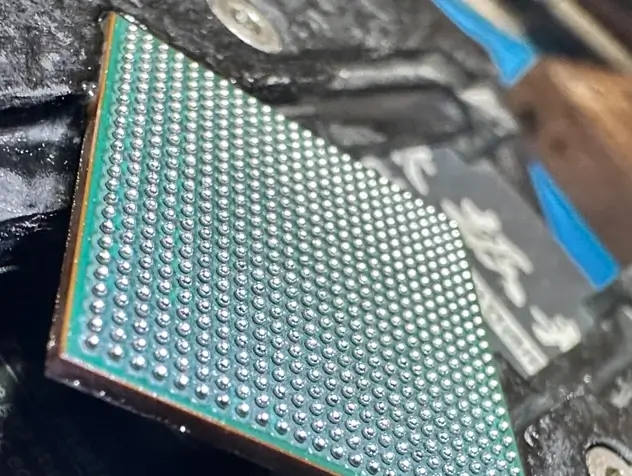
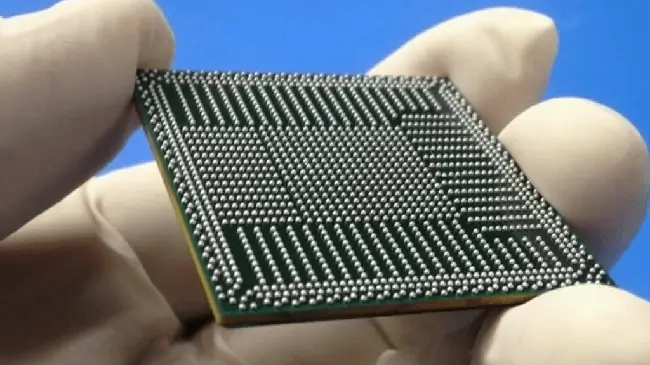
At first glance, flux residue after BGA ball mounting may not look like a serious issue. In many cases, the surface appears visually acceptable, especially when using no-clean or low-residue flux formulations.
However, in semiconductor packaging and high-reliability electronics, what you cannot see is often what causes the most serious failures.
Flux residue is not an inert material. It contains a combination of:
- Ionic compounds
- Organic acids
- Activator residues
- Carbonized flux byproducts
When exposed to moisture, heat, and electrical bias over time, these residues can become active failure drivers inside electronic assemblies.
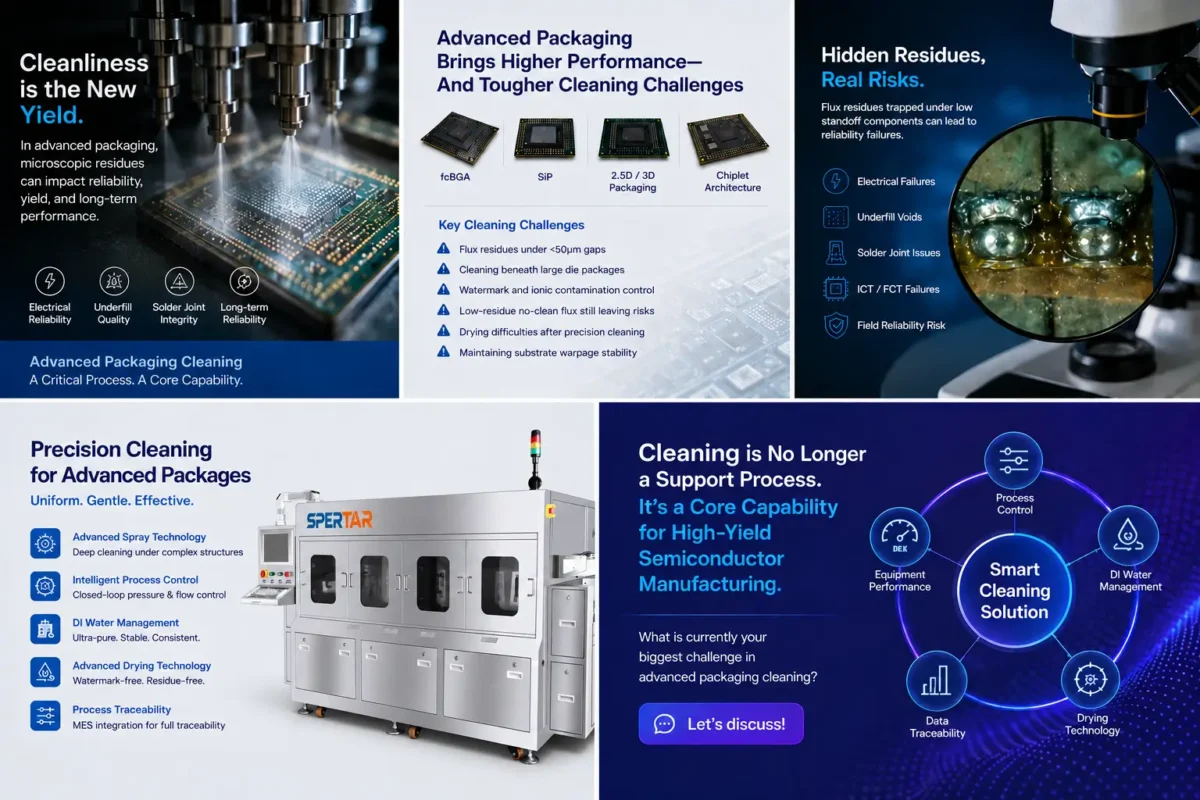
This is why in advanced packaging applications such as FCBGA, SiP, flip-chip, and automotive electronics, flux residue is not tolerated—even in microscopic quantities.
What Happens If Flux Residue Is Not Removed?
Leaving flux residue on BGA assemblies can lead to multiple reliability risks, especially under harsh operating environments.
1. Ionic Contamination and Corrosion
Flux residue often contains ionic elements such as chloride, bromide, and weak organic acids.
When moisture is present, these ions can dissolve and form an electrolytic environment on the PCB surface.
This leads to:
- Metal corrosion on solder joints
- Degradation of pad integrity
- Progressive weakening of electrical connections
Over time, this corrosion may not cause immediate failure, but it significantly reduces product lifespan.
2. Electrical Leakage Current
In high-density BGA packages, conductor spacing is extremely small.
Even a thin layer of ionic contamination can create unintended conductive paths.
This results in:
- Leakage current between adjacent traces
- Signal distortion in high-speed circuits
- Increased power consumption
- Functional instability in low-voltage designs
For applications such as AI servers, HPC, and chiplet-based architectures, even minor leakage can cause system-level errors.
3. Dendritic Growth and Short Circuits
One of the most dangerous long-term effects of flux residue is electrochemical migration (ECM).
Under voltage bias and humidity conditions:
- Metal ions dissolve from anode surfaces
- Ions migrate across residue layers
- Metallic dendrites grow between conductors
Eventually, these dendrites form conductive bridges that lead to:
- Intermittent failures
- Hard short circuits
- Sudden device breakdown
This is one of the most common failure mechanisms in field returns for high-density electronics.
4. Poor Adhesion in Downstream Processes
Flux residue also affects surface energy and adhesion properties.
This can lead to problems in:
- Underfill application in flip-chip packaging
- Conformal coating processes
- Mold compound bonding
- Thermal interface material (TIM) performance
Poor adhesion may not cause immediate failure but increases long-term mechanical and thermal instability.
5. Yield Loss and Latent Defects
In semiconductor manufacturing, not all defects are immediate.
Flux residue often creates latent defects, which pass initial testing but fail later during:
- Burn-in testing
- Thermal cycling
- Field operation
This leads to:
- Increased RMA rates
- Higher warranty costs
- Reduced brand reliability
From a manufacturing perspective, this is one of the most expensive failure modes because it appears after shipment.
Industries That Require the Highest Cleaning Standards
Not all industries treat flux residue the same way. In consumer electronics, some residue may be acceptable. However, in high-reliability sectors, cleaning is mandatory.

Semiconductor Packaging (FCBGA, SiP, Flip-Chip)
Advanced packaging technologies have:
- Extremely fine pitch interconnects
- Low standoff heights
- High current density paths
- Multi-layer signal routing
Even microscopic contamination can affect signal integrity and thermal performance.
Therefore, flux residue removal is a standard requirement in:
- OSAT facilities
- Advanced packaging fabs
- High-performance computing modules
Automotive Electronics (AEC-Q100)
Automotive environments introduce additional stress factors:
- High temperature cycles
- Humidity and condensation
- Vibration and mechanical stress
- Long operational lifetime requirements (10–15 years)
Standards such as AEC-Q100 demand extremely high reliability, making flux residue control essential for:
- ECUs
- ADAS systems
- Power modules
- Battery management systems
Medical Electronics
Medical devices require stable and predictable operation because failures can directly affect human safety.
Typical applications include:
- Diagnostic equipment
- Implantable electronics
- Monitoring systems
Even small leakage currents or corrosion risks are unacceptable in these environments.
Aerospace and Defense Electronics
Aerospace systems operate under extreme conditions:
- Wide temperature range
- Radiation exposure
- Long mission lifetimes without maintenance
Flux residue must be eliminated to ensure:
- Long-term signal stability
- Zero intermittent failures
- High mission reliability
AI Servers and Advanced Computing (CPO / HBM / Chiplet)
Next-generation computing systems rely on:
- High-speed signal transmission
- Ultra-low latency interconnects
- Dense heterogeneous integration
Applications such as:
- Data centers
- AI training clusters
- High-performance GPUs
- Chiplet-based architectures
are extremely sensitive to contamination-induced signal degradation.
Why Cleaning Is Not Optional in Advanced Packaging
As packaging technology continues to evolve, three key trends are increasing the importance of flux residue removal:
- Higher integration density
- Lower standoff height structures
- Faster signal transmission requirements
These trends make the system more sensitive to even microscopic contamination.
In modern manufacturing environments, cleaning is no longer a secondary process—it is a core reliability step in the production flow.
Transition to Cleaning Solutions
Because flux residue cannot be completely avoided during BGA ball mounting, manufacturers rely on advanced cleaning technologies to ensure reliability.
Modern approaches include:
- High-pressure spray cleaning
- DI water-based cleaning systems
- Inline continuous cleaning processes
- Controlled drying and contamination prevention systems
Among these, inline automated cleaning systems are increasingly preferred due to their:
- Process stability
- High throughput
- Integration into production lines
- Repeatable cleaning quality
In the next section, we will move from problem analysis to solution selection, including how manufacturers choose the right cleaning equipment and what technical parameters matter most in high-volume production.